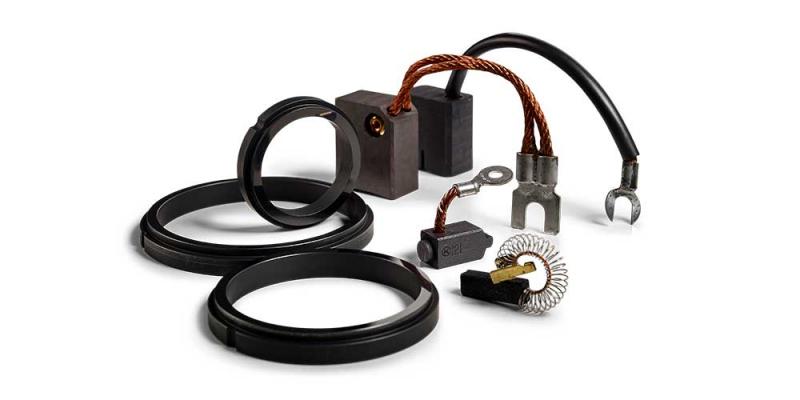
MECHANICAL CARBON
arrow_backTo the overviewCarbon sliding materials have excellent self-lubricating properties, heat resistance and chemical resistance. This means they can be used in high-temperature atmospheres where ordinary metal sliding materials cannot, and in fields where fluids and lubricants are inappropriate. Various resin- or metal impregnations can be applied to get the desired material properties in our high quality mechanical carbon materials.
EXCELLENT SELF-LUBRICATION
Carbon has self-Iubricating properties due to its layered crystal structure, making it appropriate for use in high-temperature atmospheres and in applications where fluids and lubricants are avoided. In particular, its coefficient of friction in an unlubricated condition is low compared with other materials, making adhesion difficult to occur.
EXCELLENT THERMAL DURABILITY
There are virtually no changes in the mechanical strength and slide properties due to heat.
EXCELLENT CHEMICAL RESISTANCE
With the exception of inorganic chemicals (strong oxidizers), carbon has excellent chemical resistance.
THERMAL SHOCK RESISTANCE
The coefficient of thermal expansion is lower than metal materials, and it has good thermal conductivity. This means that the material hardly ever cracks, even during rapid temperature changes.
SUPPORTS LIGHTWEIGHT DESIGNS
The bulk density is low compared to metal materials, which support lightweight machinery designs and a reduction in friction noise.


This product is added by:
Svenska Tanso AB
Your Partner in Graphite and Composites
Quality and competence are at the heart of everything we do. Since our founding in 1981, Svenska Tanso has built a leading position across Northern Europe and the Baltic states, with a growing presence in global markets.
The demand for graphite and composite solutions is constantly expanding – and becoming more complex. This is where we excel: by strengthening our expertise, broadening our experience, and delivering the reliable solutions our customers need.
Our Expertise
We provide advanced materials and solutions in:
Graphite and technic
Responsibility for content on this site
Information, images, product descriptions, videos, certifications, sustainability claims, and other content on company profiles are uploaded and maintained by the individual exhibitors.
Exhibitors are solely responsible for ensuring that their content is accurate, properly documented, and legally compliant, including compliance with applicable regulations concerning marketing, sustainability claims, and intellectual property rights.
MCH A/S solely provides the platform and does not, as a general rule, verify the content.